Learning Environments & Technology
I’m finding it difficult lately. This is surprising to me as I’ve been known to juggle multiple tasks at once and excel under pressure. I’d like to credit my father whose ability to focus on a single task for long stretches of time has long impressed me since childhood. I could blame it on the weather and the never-ending snow that falls on Ottawa or perhaps I’m just not that interested in the topic, though that couldn’t be true – I’m a PhD student after all! No, what I’ve reluctantly come around to accepting is that little screen that I keep around with me at all hours is starting to influence my ability to detach and devote more time and effort towards the thing that matters. Moreover, I’ve learned that it’s also effecting my posture, my muscles and stress levels. I’m confronted with this realization at a time when I’m looking to expand my research on educational technology and I find myself in the middle of a debate which seems to be between the advocates for technology (and its integration in to every aspect of our lives) and those that are against it (and prefer to backtrack to a simpler era served by the pen and pencil). This debate seems to apply to every aspect of our lives, but for my own research, I’m more interested in education and using evaluation to update it, transform it and enable students to integrate in to a future world that is unknown to most of us. Like any good social scientist, I approach the grey with trepidation and with an evaluator’s dedication, I look for evidence.
I’ve recently come across Carlo Iacono’s article, “Books and Screens: Your inability to focus isn’t a failing. It’s a design problem and the answer isn’t getting rid of our screen time” and found the perspective unique. Pointing to international student outcomes, Iacono recognizes the decline but rejects the notion that technology itself is the cause. Instead, he explains that this phenomenon has been seen before. In fact, he explains similar instances of transformation as it pertained to education, providing examples from Victorian England and well in to the 20th Century of the hysteria that accompanied the reading and writing of periodicals, to the fear that radio and then television was corrupting youth.
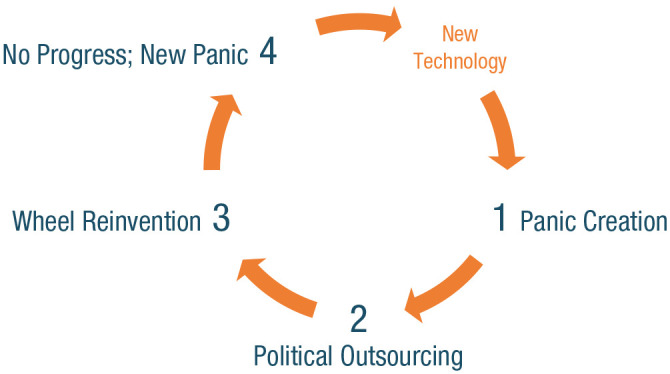
This part really captivated the historian in me – at least we know what’s coming! Technology panics are characterized by Amy Orben’s ‘Sisyphean Cycle’ whereby new technology is created and generates fear that it will disrupt and corrupt youth, politicians leverage these fears while distracting from other issues like inequality or social service underfunding, research in to causal effects starts too late and by the time sufficient data is collected to show that mixed effects are dependent on circumstances, a new technology emerges and the cycle repeats.
Iacono’s argument here is that the lack of causal evidence to support any of the fears associated with educational transformation (ie. reading) in the past, so too has little causal evidence been found surrounding the ‘corruptive’ effects of technology on student outcomes. Iacono instead looks to the learning environment, not the mode as being the cause of withering attention spans and poor grades. Rather, he argues that we should be focusing on the delivery mechanisms for learning; that our devices were designed to tap in to the phycological mechanisms that keep us glued to them and which are preventing “the kind of attention that serious thought requires.” In summary, Iacono suggests the way that technology has integrated our lives is exactly what is preventing learning AND that they were designed to be that way.
I had to pause here.
I have an internal struggle here because I have many devices and in a lot of ways, it’s made my life easier and enhanced my life in so many ways. When I fist started using them, I never would I ever have thought that we’d slowly become a slave to our devices or that corporations would purposefully, subliminally harm its customers, which it’s slowly looking like that might be the case. My naivité on fully display here, I’m learning, as I think we all are, on how to strike a balance.
At the same time, I’m also keenly observing Iacono’s re-framing of the problem – problem definition comes up frequently in my evaluation practice, but unfortunately I’ve never had the pleasure of examining it from this perspective; it’s usually forward looking and not backward. This is a great example of how time and energy can be wasted (ie claiming one leads to the other) if sufficient research isn’t conducted that point to causality. It also underscores the use of evaluative and critical thinking in determining solutions and advanced several evaluative if / then statements: “if the problem is design, the we need to design activism and regulatory intervention.” This means…
“the same screens that fragment attention can support it. The same technologies that extract human attention can cultivate it. The question is who designs them, for what purpose and under what circumstances.”
Just as educators know that all students learn differently; some need written words while others work best in listening, it will be necessary to assess learner preferences in their interactions with technology.
We haven’t become post-literate. We’ve become post-monomodal...The real problem isn’t mode but habitat. We don’t struggle with video versus books. We struggle with feeds versus focus.
Enter educational technology specialists and the modernizing the education system.
Where do we begin?
We brainstorm – what do we want a future education system to look like. I’ve heard many ideas that go in many different directions. My suggestion would student-focused, first and then expand to what needs to happen or be in place for the student to succeed. An evaluator (or evaluation team) would facilitate the conversation with various representatives who have a stake in this endeavour and lead a collaborative process that generates a roadmap for next steps – on establishing indicators of progress, data and monitoring mechanisms to generate evidence, workplans and timelines and establishing a research agenda alongside this important work, while documenting good practices for future action.
I’m excited and prospect of this transformation and hope that my research can contribute to its success.